My family will tell you that they rarely see me without yarn in my lap. I’ve been crocheting since I was 7 years old and it’s definitely my favorite hobby. There’s something very soothing about the yarn flowing through my fingers – and unlike my profession, at the end of an hour, I have something physical to show for my work.
After the holidays, I saw a post on a neighborhood Facebook page asking if anybody was interested in forming a crochet club. We had a bit of a false start, but another lady and I have now started a group that is meeting the second Saturday of each month at our local library to crochet together. At our last count, there are 19 members of the group now at all ability levels. We’re still kind of figuring out what we want to do with our meet ups, but I’ve been focusing on teaching people who are new to crochet.
If you are really unfamiliar with crochet, it is done with a hook – not two straight needles. That would be knitting. Crochet has one open loop at any given time but knitting can have hundreds of open loops. Here’s a fun fact – unlike knitting, crochet cannot be duplicated by a machine. So if someone has made you a crochet item, it’s very special!
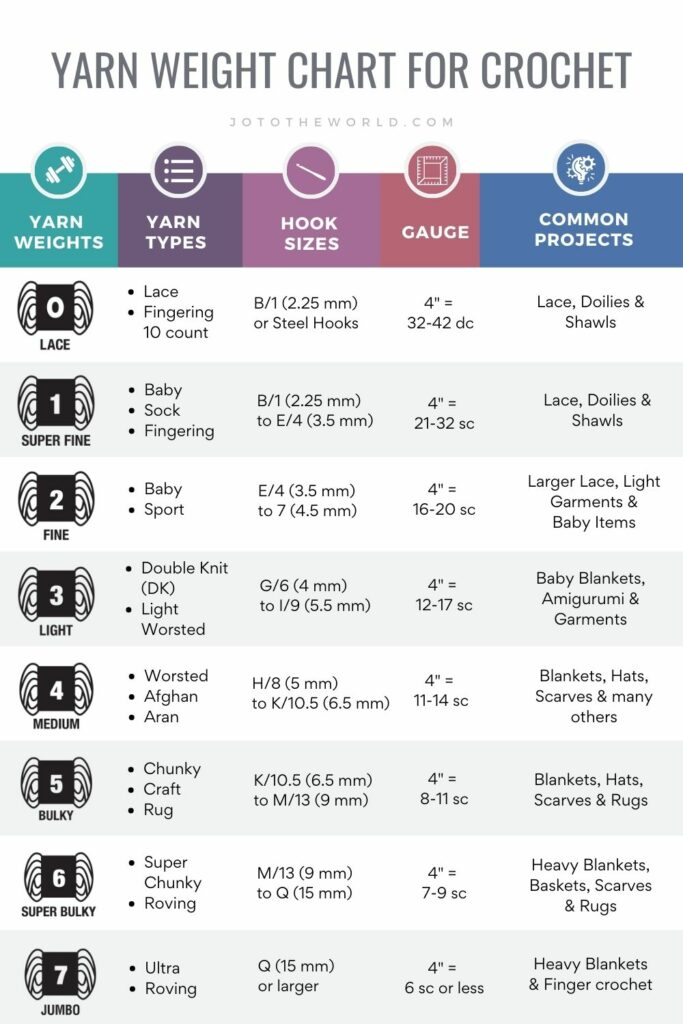
The great thing about crochet is that it is really easy to get started – you can do it for less than $10 because really all you need is a ball of yarn and a hook. I’d suggest starting with some cheap acrylic yarn in a 4 weight (the wrapper on the yarn will have a number on it – 4 is a mid-weight yarn) and a size H hook. Then it’s just a matter of learning basic stitches and practice so your tension is even.
The basic stitches (and their pattern abbreviations) are listed below in ascending order of the length of the stitch:
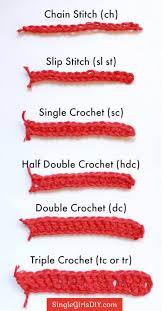
- Chain (CH) – used as the foundation in most projects and to provide spaces or transitions in a piece.
- Slip Stitch (Sl St) – think of this sort of like a slip knot that joins rounds. Slip stitches can also be used to help you move from one section of a piece to another without the need to cut the yarn as well as for a decorative effect.
- Single Crochet (SC) – creates a dense fabric with no holes. Single crochet should probably be the first stitch you learn because all other stitches build on the mechanics of this stitch. It’s used for everything from stuffed animals to blankets to wearables.
- Half Double Crochet (HDC) – creates a dense and sturdy fabric again with no holes.
- Double Crochet (DC) – this stitch is less dense so the fabric created is much more pliable but because of the length of the stitch, there are “spaces” created between stitches.
- Triple Crochet (TR) – this stitch is the longest of the basic stitches and is generally used for a really open, flowy fabric or for decorative effect.
Once you have all the basic stitches mastered, it’s just a matter of mixing them to create practically anything! Here are some resources to learn crochet – try it, it’s addictive!!!!
- https://sarahmaker.com/basic-crochet-stitches/
- https://www.thesprucecrafts.com/basic-stitches-in-crochet-978516
- https://www.mamainastitch.com/basic-crochet-stitches-for-beginners/
- Or – you can always search the name of any stitch on YouTube. There are LOTS of tutorials there for both right and left handed people.
- Last but not least – this chart is really helpful when getting started:
 Learn Or Do