Time for the Olympics!

Friday is the opening ceremony for the Summer Olympics in Paris – but what do you know about the very first Olympics?

The very first recorded Olympics were held in Greece in 776 BC. No swimming, diving or gymnastics, but they did have a running race! Those first Olympics were part of a festival honoring the god Zeus who was the father of all the Greek gods and goddesses. The only event was the stadion race – a 600 foot running race in Olympia – near Mt Olympus. According to the Penn Museum, there is evidence that this festival and race went back to even earlier dates – but there is no recorded history prior to the 776 BC event. The winner at that first recorded stadion race? A cook named Koroibos from the neighboring town of Elis. His prize? A wreath made of olive leaves and of course a place in history!

The stadium at Olympia. It could hold around 2,000 people – who sat on mud seats!

Initially a 1 day event, the addition of more types of competition lead to it expanding to a 3 day event by 708 BC. Additional competitions included additional running distances, jumping and the discus throw. More and more sports were added over the years like the javelin, long jump, shot put, boxing, wrestling, riding and chariot races – and kept increasing the length of the festival as well. By the fifth century BC, the festival was at least 5 days long to accommodate the growing lists of competitions.

The ancient games continued until 393 AD when the Emperor Theodosius ended the festivals honoring the Greek gods because of the rise of Christianity. The games, with their roots in paganism came to an end and the stadium at Olympia was reduced to ruins by a series of earthquakes, floods and mudslides.

The modern Olympics were re-established in 1896 by a Frenchman named Baron Pierre de Coubertin. His original intent was to unveil modern Games in 1900 in his native Paris, but delegates from 34 countries were so enthralled with the concept that they convinced him to move the Games up to 1896 and have Athens serve as the first host. So the Olympics starting this week in some ways are coming full circle!

Want to know more about the Ancient Olympics? Check out these links:

Throwing back to Hamilton

220 years ago today Alexander Hamilton and Aaron Burr fought their famous duel. You might want to screen “Hamilton” on Disney+ today to celebrate!

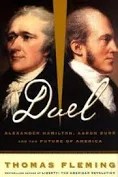
I recently read a great book about the duel – oddly enough titled “Duel” by Thomas Fleming. Cannot recommend reading this book enough! It does an amazing job of diving into the political atmosphere of the time and the roles that both Hamilton and Burr played in it. In school we’re just taught that they dueled – not a lot about the circumstances so this book really gives you a detailed picture of who the two men really were and why they ended up facing each other over pistols. Give it a read – you won’t regret it because it’s a real soap opera!

Find the book on Amazon here: https://www.amazon.com/s?k=duel+thomas+fleming&hvadid=409971055199&hvdev=c&hvlocphy=9021498&hvnetw=g&hvqmt=e&hvrand=11310651608290146802&hvtargid=kwd-18321286397&hydadcr=22538_11318434&tag=googhydr-20&ref=pd_sl_86bk7pb7h2_e

Enjoy this clip featuring the cast of the musical Hamilton from the 2016 Tony Awards.

First inauguration

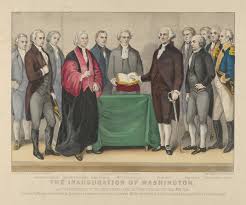
On this day in 1789, our first President was inaugurated for his first term in office. George Washington’s term as our first President actually began on March 4, 1789 as proscribed by the new constitution – but sadly logistical delays with ballot counting caused the inauguration to be delayed by nearly 2 months. Poor George didn’t even get official notification that he had been elected until April 14, 1789. He set out for New York City, which was serving as the nation’s capital two days later.

The inauguration was held at Federal Hall with Washington being sworn in by the Chancellor of New York, Robert Livingston rather than the Chief Justice of the Supreme Court as is the norm today. Here are some more fun facts about that first inauguration:

  • Washington actually had to borrow cash to make the trip from Mount Vernon to New York City! He borrowed 600 pounds (dollars weren’t a thing yet) at 6% interest from merchant Richard Conway. Despite owning a plantation – and slaves – Washington was cash poor at the time of his election to the Presidency. In fact, he joked with family that part of the reason he accepted the job was for the salary.
  • There were no inaugural balls. But a week later there was a ball honoring Washington so maybe that counts?
  • By Congressional resolution, Washington and members of the inaugural party processed straight from the ceremony at Federal Hall to St. Paul’s Chapel for Divine Service.
  • Washington’s inaugural speech was only 1,419 words long – taking about 10 minutes to deliver. George apparently believed in brevity – his second inaugural address was only 135 words! (not a typo – really 135 words!)

Want to know more about George Washington? I can tell you he was a complex character – not at all like the one dimensional saint we learned about in school! I suggest these resources:

American History

My throwback today is about learning more American History. So many of the things we learned in American History when we were in grade school or high school are REALLY abbreviated versions of the story. Lately, I’ve put aside reading fiction in favor of reading history books.

I’ve been fascinated by a book called “Duel” by Thomas Flemming about the duel between Aaron Burr and Alexander Hamilton. I’m just about to the day of the duel – 294 pages in. The author does a really great job of setting the political scene of the day and diving into the relationship between Burr and Hamilton. It took years and years of friendship, political intrigue and rivalry to get to the dueling field in New Jersey. I cannot recommend this book highly enough – it’s available for Kindle so I’ve been reading it on my phone in spare moments and cannot wait to get to the aftermath of the duel!

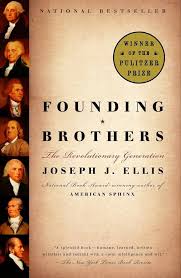
I’m also reading a book called “Founding Brothers” by Joseph Ellis – a real live paperback book! This book takes closer looks at particular episodes in history involving George Washington, Thomas Jefferson, John Adams, James Madison, Alexander Hamilton and Aaron Burr. The author does an amazing job of diving into the personalities of these history book characters and giving you a better sense of the actual men. The episode I’m currently up to is regarding why Washington DC is our nation’s capital.

After I’m done with these two books, I’m going to dig into biographies of some of our founding fathers. I’ve read the Ron Chernow books on Hamilton and Grant so maybe his book on Washington would be a good next read. But I also want to read “Team of Rivals” by Doris Kearns Goodwin. I think she’s really interesting when I see her interviewed but I’ve never read her!

I’m loving the perspective reading deeper into history is giving me about the ways of the world today. It really is true that those who forget history are doomed to repeat it.

I’d love your recommendations for books on history – please leave them in the comments!