Red Nose Day is Coming!

I know – you’re probably asking why I’m talking about a day that is coming up on Throwback Thursday.  I’ll get to it.  But first, what do you know about Red Nose Day?

Red Nose Day originated as event of the charity organization Comic Relief in the U.K.  Comic Relief dates back to 1985 and a BBC telethon hosted by Noel Edmonds from a refugee camp in Sudan in response to the famine in Ethiopia.  Since then, Comic Relief has raised money for a variety of causes including HIV and AIDS education in Africa, childhood immunizations, domestic violence and the disabled.  Comic Relief started the Red Nose Day Telethon in 1988 to raise funds to help children in need and fight worldwide poverty.  Why the Red Nose?  It was intended to be a run, kid-friendly conversation starter for the fund raising effort.

In 2015 through a partnership with Comic Relief, NBC and Walgreen’s, Red Nose Day was brought to the U.S.  Since then, more than $60 million has been raised in the U.S alone and donated to organizations including Oxfam, Feeding America, Children’s Health Fund, Save the Children and Boys’ & Girls’ Clubs.

This year, the U.S. Red Nose Day Telethon will air on NBC on Thursday, May 24th.  So you have a couple weeks to figure out how you can get involved.  It can be as easy as going to your neighborhood Walgreens or Duane Reade and buying an official Red Nose for a dollar.  Wear your Red Nose and post to social media.  Or buy other Red Nose merchandise to promote the event.  Want to organize your own Red Nose event?  Check out the ideas here:  https://rednoseday.org/fundraising

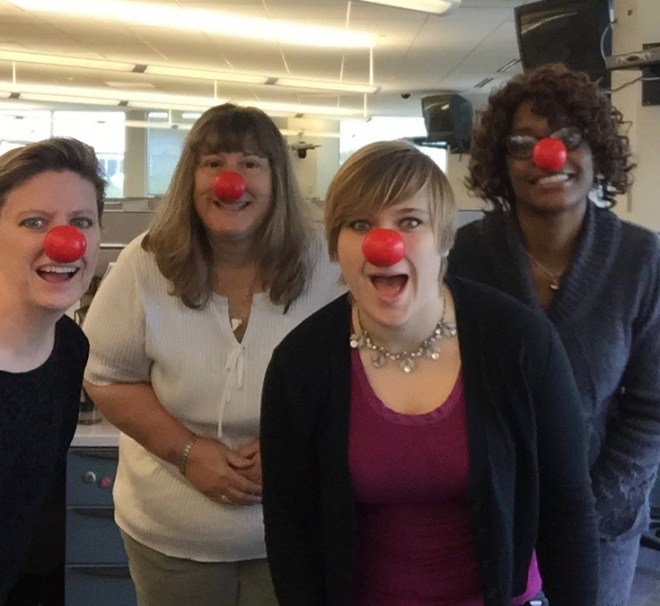
It’s a great cause – you really can help make a difference in a child’s life.  And now the Throwback.  Here’s a picture of my work team on the very first U.S. Red Nose Day in 2015!
IMG_0258

Pilates

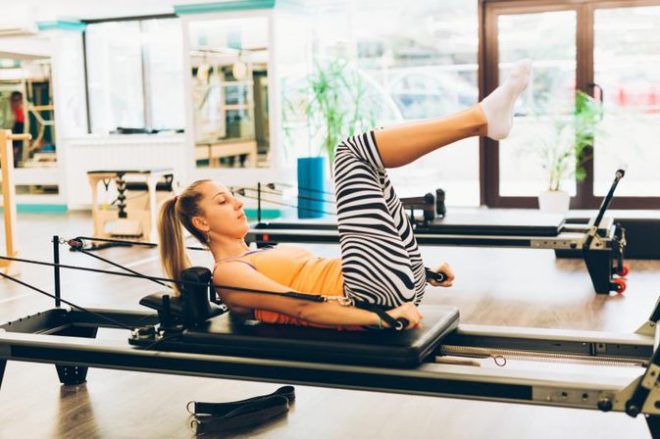
My gym awarded me with a free Pilates workout with a personal trainer for my birthday.  I need to get it scheduled – but I was curious about the Pilates machine so I’ve done a little homework so I know what to expect.

First of all, the machine is called a reformer.  And it looks a little bit like it may be a Medieval torture device.  It’s kind of like a bed that rolls up and down the frame and it’s all about building your core muscles through resistance supplied by straps and springs built into the device.

Click here for a great description of the reformer and its benefits.

All I can say is that I’m glad I’m a fairly flexible person and that I’ll be working in a private session with a trainer.   Click here to see what a basic workout looks like.  I think I’m going to be sore!

Pilates.jpg

Grill time!

It’s supposed to hit 80 degrees here today!  And you know what that means right?  It’s time to grill!  But my grill hasn’t been used since October, so it’s time to give it a good cleaning and get it ready for summer.  And then I’m going to prep for supper tonight….

This video gives a really great overview of how to clean your grill:


And here’s how to make my favorite dinner on the grill – Enjoy!

Screen Shot 2018-05-08 at 10.04.44 AM

First Internet Virus

virus-detectedWe all know we’re not supposed to click on links in emails from sources we don’t know because of viruses – but where did they come from?

Computer viruses have existed since the 1970’s but the first documented virus widely spread through the internet happened in 1988.   Known as the Morris worm, it was a piece of coding developed by Robert Morris who was a graduate student at Cornell University.  Morris claimed that he wrote the code as an innocent means to attempt to gauge the size of the internet.  But the coding exploited weaknesses in the Unix operating system, file transfer protocols and weak passwords and rather than just counting internet sites/pages it began replicating over and over until infected machines became bogged down in code and crashed.

At the time of the Morris worm, it was estimated that there were approximately 60,000 computers attached to the internet – and that the virus impacted at least 10% of them at a cost in lost productivity of as much as $10 million.  Seems quaint given the size of the internet today doesn’t it?

But the impact of the Morris worm lead to the establishment of government entities to coordinate and respond to networking emergencies so there was a silver lining to the event.  And what happened to Robert Morris?  He became the first person convicted of a felony under the 1986 Computer Fraud and Abuse Act serving 3 years of probation, 400 hours of community service and paying a $10,500 fine for releasing the virus.

Want to know more about Robert Morris and the Morris worm?  Check out these links:


Throwback Thursday

It’s Throwback Thursday!  Staring at my blank computer screen this morning, I realized I had no idea how this popular meme got started so I did some digging.

Sports Illustrated magazine attributes the first use of Throwback Thursday to a sneaker blog named “Nice Kicks.”  In 2006, the blog started posting pictures of old basketball shoes and titled them Throwback Thursday.  The popularity of the pictures went viral with the hashtag #TBT and a meme was born.

While #TBT is used across social media, it is arguably most popular on Instagram where according to Wikipedia it has been used more than 200 million times!

If you don’t like posting your old pictures using #TBT, maybe you’d like to participate in the similarly themed Flashback Friday (#FBF)?  Or if you want to get off memory lane entirely, how about a post for #MondayMotivation with an inspirational quote or story to get the week off to a good start.

I’m in the spirit of #TBT so here’s my throwback to 2008:

1931248_44551541946_8080_n

Spring Allergies

UNUSED-Spring-Allergies-GraphicI’m lucky – I outgrew my allergies.  But I know a lot of people are starting their annual season of suffering as the pollen counts rise.  All the sniffling and sneezing, coughing and itching isn’t fun so while you’re waiting for your allergy medications to kick in, let’s think about other ways to help alleviate the misery.  Here are some tips I’ve heard are helpful:

  • Stay indoors when you know the pollen counts are going to be high.  Local news broadcasts are pretty good about warning you on high pollen count days.  While pollen counts can vary widely based on plant activity, weather and time of day, on average the pollen count is lowest right before dawn, peaks around mid-day and then falls through the afternoon/evening.
  • Keep up on the housecleaning.  Vacuum more than once a week and don’t be stingy with the Swiffers.  Anywhere dust can build up, pollen is hiding too.  And don’t forget to change the filter on your furnace/AC regularly too!
  • Try a saline nasal spray or neti pot.  Twice a day nasal rinses help clear the pollen from your membranes.  And a salt water gargle can help with a scratchy throat too!
  • Take a shower at night to get all the pollen off of you and out of your hair so you don’t deposit it all in your bedding.  Change your clothes after you’ve been outside – and leave your shoes at the door.   And don’t neglect your pets either – your dog may be a regular pollen ball if you aren’t making sure it is groomed regularly too.

Do you have a favorite trick to minimize the agony of allergies?  Let us know in the comments!


Grass

grassTop of my to-do list today?  My lawn looks sad.  Now that we have finally left winter behind, it’s time to get to work outside.  The winter – or the neighbor’s dog – wasn’t kind to a couple spots in my front yard and now I have bare patches.
I’ll be making a trip to the hardware store for some grass patch – and maybe I’ll throw in a bag of plain grass seed to overseed the rest of the yard as well.

Have you ever used grass patch?  There are several brands, but basically, it’s a blend of grass seed, fertilizer and mulch.  You loosen the soil in the bare spots down about an inch or so and then spread the patch over it.  When you water it, the patch turns into a sort of paste that keeps the seed in place and holds moisture in around it.  Water at least once daily for a week to 10 days and you should have grass filling in those bare spots.  It’s easy!

Overseeding is putting seed over a lawn that is thin or uneven.  To prep for my overseeding, I’ll rake the yard gently to loosen up any thatch so the seeds can get down to the soil.  If your seeds stay in the existing grass or in the thatch, they aren’t going to grow so this is an important step.  I have a handheld seed/fertilizer spreader so I’ll put the seed down with that and then follow up with a little more light raking to make sure the seed gets down to dirt.  Then it’s just a matter of watering regularly until my lawn fills in and isn’t so sad!

Want a guide for spring lawn care?  I like this one from Today’s Homewoner.

Electric Cars

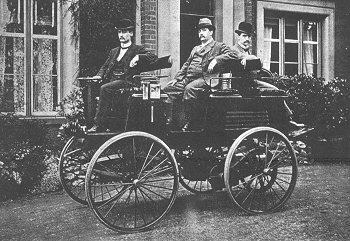
You might think electric cars were a relatively new thing – but you’d be wrong.  The first practical, production electric car was actually built in 1884 by a man named Thomas Parker in London.

Sometimes described as the “Edison of Europe,” Thomas was a machinist by trade, but his insatiable curiosity lead him into chemical engineering where he developed improvements to lead-acid electric batteries and designed his own “dynamo” which is an electric generator using direct current.  Parker’s dynamo was capable of generating enough power to run the whole electroplating department at the factory where he worked – a first for the time which earned him a silver medal at the British Smoke Abatement Exhibition of 1881.

Thomas_Parker_Electric_car
Thomas Parker (middle) in one of his electric cars.

After this, Parker started a partnership with Paul Bedford Elwell who ran a family factory producing nails and horse shoes.  Elwell-Parker began producing dynamos that lead to the first electric lighting in mines, the first electric trams – and the first electric cars.

As the world moved into the 20th century, electric cars were the preferred type of motorized vehicle with over 30,000 of them on the roads at the beginning of 1900.  But improvements in the internal combustion engine lead to gas powered cars having an advantage over electric with greater driving range and lower refueling times.   The rapid expansion of the petroleum infrastructure and introduction of the electric starter motor for gas powered cars meant no more hand cranking and demand for electric cars faded away.

But in the 1990’s electric cars started to make a comeback fueled by regulations on fuel efficiency and emissions.

In 1996, GM introduced a limited version fully electric car called the EV1 in Califormia and in 1997, Toyota launched a fully electric RAV4 (as well as the Prius hybrid).  Since then, the Tesla Roadster, the Nissan Leaf and the Chevy Volt have become best selling fully electric cars.   Doubt their popularity?  Then don’t go to Norway – 39% of all new car sales there are fully electric vehicles!

Manufacturers are stepping up their electric vehicle production too – Volvo announced in 2017 that they would be phasing out combustible engines beginning with the 2019 model year.  So next time you head to the dealership for a new car, you may be surprised at all the electric vehicles available to you!