Month: March 2024
Coding for fun?
I’m taking a class in SQL today. Brushing up on coding is good for me but I’m reminded of my first coding class – which seems like it was a million years ago….

I had to be able to code in both COBOL and Pascal when I was in college. I’m sure both of them are dead now! This is so long ago that we used punch cards for the programming. And dinosaurs roamed the quad too. But I was punching my cards and maybe got a little over-enthusiastic – which caused my program to work in an infinite loop in an if/then statement. I crack up every time I code something now remembering that. Good times!
Did you ever code in COBOL or Pascal? Or use punch cards? Let me know in the comments – but I really hope not!
Gotta run – I’m just on a break!
What’s New in Wellness?
I’m working on an application for a Marketing Director position with a nutrition company. I’m a believer in vitamins and health supplements so I’m enthusiastic about the role – it would allow me to use my experience and skills to help make a difference in people’s lives.
I take a Women’s multivitamin, extra Vitamin D, extra Vitamin E and an eye health vitamin every day (almost – I tend to forget them on days that I get out of a normal routine). Why? Well, like many women, I try to eat a healthy diet, but life can get in the way of that! I make it even harder on myself since I live alone – making the quantity/variety of food I cook challenging.

Why do I take what I do? Well, I think a multivitamin is sort of like an insurance policy. It helps ensure I get iron, Vitamin C and various minerals that I might not quite get from my day to day diet. As a woman, iron and calcium are really important to me so the multi-vitamin gives me a little boost.
My OBGYN recommended extra Vitamin D because I’m an inside worker so I may not get it naturally via sunlight particularly during the winter. And I’m very fair skinned so I avoid a lot of sun in the summer so I don’t get burned! Vitamin D helps your body absorb calcium – and ladies, as we age we want to maintain calcium levels to help avoid osteoporosis. I figure a little boost here can’t hurt. I don’t want broken bones!
I take extra Vitamin E because it has anti-oxidant properties and it’s good for your skin and your eyes. And years ago my OBGYN recommended it as a way to help relieve monthly cramping. That was reason enough for me to take it but I also think it’s part of the reason I have very few issues with my complexion.
Last but not least, my Opthamologist has been tracking the onset of macular degeneration in both of my eyes. I had cataracts removed from both eyes at a fairly early age and I’m also showing signs of macular degenerations very early. I have spots in both eyes that are areas of concern although I haven’t started with any noticiable symptoms in my vision yet. So I take a daily eye health vitamin as well. I prefer Ocuvite since it’s only 1 capsule a day. Eye Health vitamins typically contain Lutein and Zeaxanthin which are related to Vitamin A and help keep your retinas healthy.
Want more info about Vitamins? Check out these links!
Meal Planning?
This to-do Tuesday, I’m planning what I’m cooking for Easter dinner. It’s going to be a small gathering at my house, but that doesn’t mean I don’t want to plan a lovely meal!

I’m going sort of traditional – I have a small ham. Tiny – but adorable! I’m going to glaze it with a brown sugar/honey/orange juice concoction of my own. I’m sure you all have seen glaze recipes that are similar right?
Side dishes…. Decisions, decisions! I don’t want tons of leftovers so I may go kind of traditional with sides too. A personal favorite for me is green bean casserole – and I have all the ingredients in my pantry at pretty much any given time so that’s a plus! But I’m thinking roasted veggies as a second side – potatoes, carrots and asparagus. YUM!
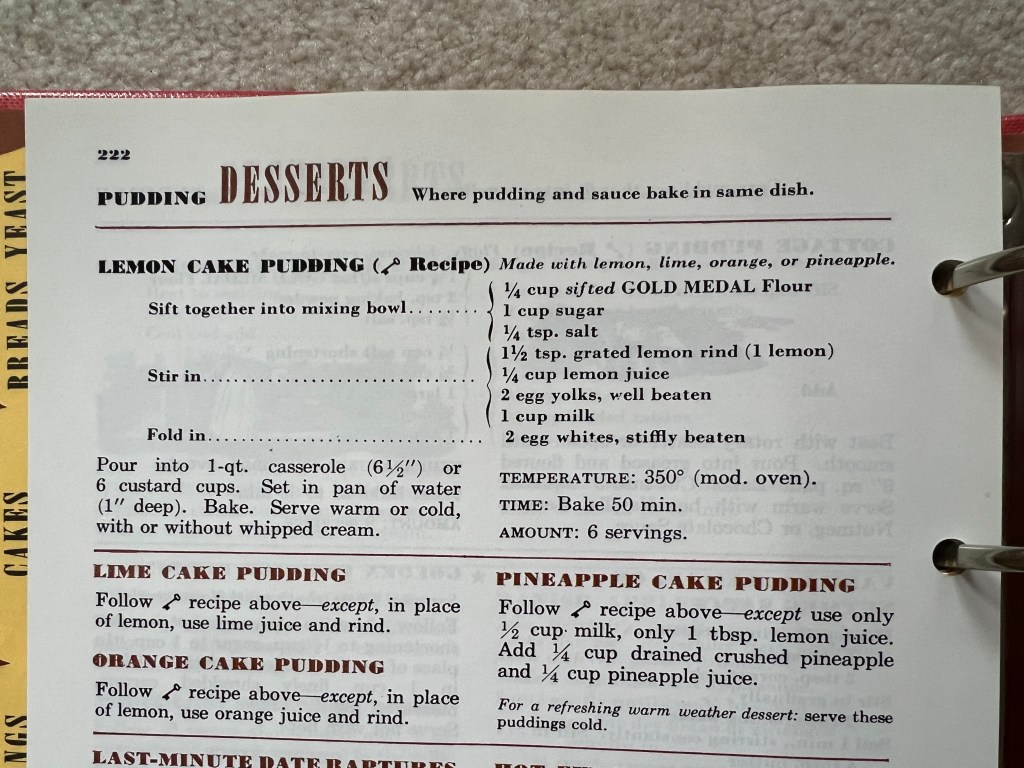
Desert? I’m going back to an oldie but goodie – Lemon cake pudding. It’s fun – you bake it in a water bath and the batter separates into pudding and cake.
Here are my main dish recipes for you to try – I’d love to hear what you’re planning in the comments!
- https://www.campbells.com/recipes/green-bean-casserole/
- https://www.cookingclassy.com/garlic-herb-roasted-potatoes-carrots-and-green-beans/ (I’m substituting asparagus for the green beans)
- The recipe for the Lemon Cake Pudding is SO OLD I can’t find a link to it! So here’s a picture from my Mom’s copy of the Betty Crocker Cookbook:
Friday Funny
I love actors breaking character!
Throwback toys!
With Easter just a couple weeks away, I have an idea for those of you that are putting together Easter baskets. At Christmas, my family on my mom’s side always does a funny gift exchange – last Christmas, our theme was things that were introduced the year you were born. That’s it’s own whole story since the family group ranges in age from pre-school to in the 90s! But I found fun toys launched the year I was born – and they might be a fun option for your Easter basket joy!
Have you seen these World’s Smallest Toys? They’re adorable – and they’re actually functional! Here’s a link to the store for them on Amazon, but I’ve seen them in all sorts of brick & mortar stores so they shouldn’t be too hard to find in time for Easter.

Measles outbreak?
As of yesterday, there were 15 confirmed cases of measles in Chicago this year. In a city of more than 2.75 million people, that doesn’t seem like a lot – but measles are extremely contagious and spreads via airborne virus.
Before the introduction of the measles vaccine in 1963, it wasn’t uncommon for an epidemic of measles every 2-3 years – and measles killed an estimate 2.6 million people per year.
So what is measles? It’s a respiratory tract infection characterized by a high fever, cough, runny nose, red/watery eyes and a rash that spreads over the whole body. In addition, about 10% of people who contract measles will have ear infections and another 10% will suffer from diarrhea. So it’s not pleasant!
If you’re unvaccinated and contract measles, you have a 20% chance of needing to be hospitalized. Other complications can include pneumonia, encephalitis and even death.
In 2000, measles was declared eliminated from the U.S. (defined as no disease transmission for more than 12 month) thanks to a highly effective vaccination program. However, in recent years the percentage of children receiving the vaccine has been dropping. for the 2022-23 school year, national coverage for the measles vaccine was at 93% – 2% lower than what is needed to achieve herd immunity. Theories on the drop all center around impact from the Covid pandemic and range from timing issues for wellness visits being disrupted to vaccine fatigue. Misinformation about the safety and effectiveness of the vaccine is also contributing to the drop.
The good news? For those of us who have had the 2-dose measles vaccine, we should be covered for life. Children should receive their first dose of the vaccine when they are between 12 and 15 months old with the second dose administered when they are between 4-6 years old. Did you miss getting a vaccine as a child? Adults can also be vaccinated – see your healthcare provider for timing for the 2 shots.
Measles is a serious disease that at minimum could cause you a couple weeks of misery – or send you to the hospital with complications that aren’t great. So make sure you and your kids are covered as the disease is making a bit of a comeback! Want to learn more? Check out these links:
- https://www.cdc.gov/measles/index.html
- https://www.who.int/news-room/fact-sheets/detail/measles
- https://www.pbs.org/newshour/health/measles-cases-are-rising-in-the-u-s-heres-why-misinformation-about-the-vaccine-persists-today

Let’s crochet!
My family will tell you that they rarely see me without yarn in my lap. I’ve been crocheting since I was 7 years old and it’s definitely my favorite hobby. There’s something very soothing about the yarn flowing through my fingers – and unlike my profession, at the end of an hour, I have something physical to show for my work.
After the holidays, I saw a post on a neighborhood Facebook page asking if anybody was interested in forming a crochet club. We had a bit of a false start, but another lady and I have now started a group that is meeting the second Saturday of each month at our local library to crochet together. At our last count, there are 19 members of the group now at all ability levels. We’re still kind of figuring out what we want to do with our meet ups, but I’ve been focusing on teaching people who are new to crochet.
If you are really unfamiliar with crochet, it is done with a hook – not two straight needles. That would be knitting. Crochet has one open loop at any given time but knitting can have hundreds of open loops. Here’s a fun fact – unlike knitting, crochet cannot be duplicated by a machine. So if someone has made you a crochet item, it’s very special!
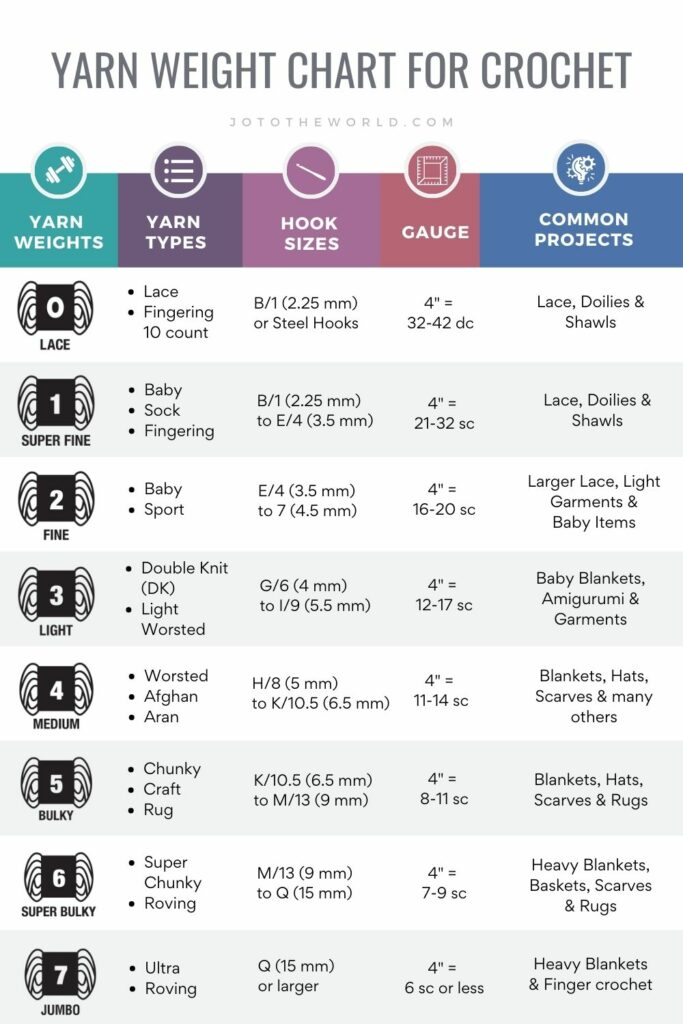
The great thing about crochet is that it is really easy to get started – you can do it for less than $10 because really all you need is a ball of yarn and a hook. I’d suggest starting with some cheap acrylic yarn in a 4 weight (the wrapper on the yarn will have a number on it – 4 is a mid-weight yarn) and a size H hook. Then it’s just a matter of learning basic stitches and practice so your tension is even.
The basic stitches (and their pattern abbreviations) are listed below in ascending order of the length of the stitch:
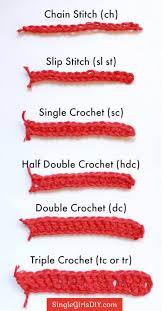
- Chain (CH) – used as the foundation in most projects and to provide spaces or transitions in a piece.
- Slip Stitch (Sl St) – think of this sort of like a slip knot that joins rounds. Slip stitches can also be used to help you move from one section of a piece to another without the need to cut the yarn as well as for a decorative effect.
- Single Crochet (SC) – creates a dense fabric with no holes. Single crochet should probably be the first stitch you learn because all other stitches build on the mechanics of this stitch. It’s used for everything from stuffed animals to blankets to wearables.
- Half Double Crochet (HDC) – creates a dense and sturdy fabric again with no holes.
- Double Crochet (DC) – this stitch is less dense so the fabric created is much more pliable but because of the length of the stitch, there are “spaces” created between stitches.
- Triple Crochet (TR) – this stitch is the longest of the basic stitches and is generally used for a really open, flowy fabric or for decorative effect.
Once you have all the basic stitches mastered, it’s just a matter of mixing them to create practically anything! Here are some resources to learn crochet – try it, it’s addictive!!!!
- https://sarahmaker.com/basic-crochet-stitches/
- https://www.thesprucecrafts.com/basic-stitches-in-crochet-978516
- https://www.mamainastitch.com/basic-crochet-stitches-for-beginners/
- Or – you can always search the name of any stitch on YouTube. There are LOTS of tutorials there for both right and left handed people.
- Last but not least – this chart is really helpful when getting started:
Return to format!
Given how slow my job search is going, I think it’s time to return to the real format for Learn or Do – so starting today, I’m going back to the original themed content by day and cutting back on the focus on job search. I feel like it has gotten repetitive – and that’s BORING! LOL!
So it’s apropos that today is Monday – it’s the first day of return to format which fulfills the Monday theme of firsts. So let’s remember as well, that the original purpose of this blog was to try to prompt my readers (and myself) to learn or do something new every day.
So here’s a fun first I bet you didn’t know – on March 18, 1662, the first public bus service started in Paris. The bus service was called Carosses a Cinq Sous and was meant to try to relieve traffic in Paris during the reign of Louis XIV. Famous mathematician Blaise Pascal was one of the instigators for the service – who better than a mathematician to recognize the problems of traffic?

There were 5 routes for the carriages with a published schedule. The carriages were staffed by a driver and a footman and could carry up to 8 passengers. However, soldiers, pages, and other liveried men were barred from riding in the carriages “to assure the greater comfort and freedom of the bourgeois and meritous classes.” Remember, Europe of the 1600’s was very class stratified so as unfair as this might seem to us today, it was a fact of life then.
Want to know more about Carosses a Cinq Sous or Blaise Pascal? Check out these links!
Friday Funny
Is it a test? LOL!!!
 Learn Or Do